When playing in a minor key, we can use chords not just from the natural minor, but also from the harmonic minor and melodic minor scales. You will quickly discover that real-life music rarely sticks exclusively to the major and minor keys. There's a common device called modal interchange, where you have a major-key song that borrows from the parallel minor key, or vice versa.

In C major, your song will sound a lot more interesting if you bring in chords from C minor. It's also pretty common to have a song that's in C minor everywhere except for the actual root chord, which will be C major instead. It sounds like a weird idea, but it's a very common songwriting technique. In this post you'll learn how to build chords of the minor scale, create your own chord progressions and analyze the chord progressions of famous songs in a minor key.
The chart below uses the chord numbering system to show the relationship of guitar chords in all the minor keys. Find a key in the left column and the chords that belong to the key are shown in the corresponding row. All the chords listed in the row for the key of Gm will sound nice when played together in various chord progressions. Three of the keys share notes with three other keys, they are called enharmonic. They may look the same on a guitar or piano, but look very different in sheet music.
C♭ Major and B Major are enharmonic, C♯ Major and D♭ Major are enharmonic, and F♯ Major and G♭ Major are enharmonic, sharing notes on a guitar. C Major is the best key to study the patterns of chords, as there are no extra sharps and flats to contend with, counting out notes in the scale is easier. It is nice to have all fifteen keys for reference, but in practical use a guitarist may only play a few of these keys.

Guitar is easier to play when at least some of the open strings are in the key. The key is C, but it looks like they are avoiding C chords. You can use major pentatonic scales over the major chords and minor pentatonic scales over the minor scales. You may want to try F lydian mode since it's the key of C without a C chord, yet they use F major a lot.

Also, I wouldn't use pentatonic scales to figure out a key because they remove notes so they can be played over more chords. Especially in jazz and latin music m9 chords are very common. Here the next tone after E is an F (just a half-step away) and that is a b9. The b9 sounds just awful in a m7 chord and the 9 (F#) doesn't belong to the C major scale.

Often a change of key is generated by adding a corresponding dominant 7th chord and voila! – the 9 works in that case, for example in the progression Em9 A13 Dm9 G13 Cmaj7. Diminished keyboard chords are less common than major and minor chords, but are still frequently used in rock and pop songs. The most common use of a diminished chord is to transition between two other, more stable-sounding chords.
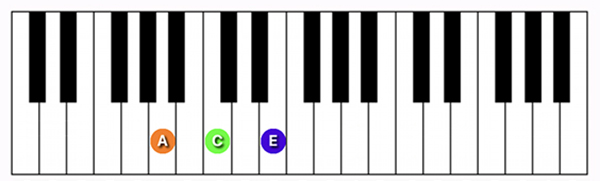
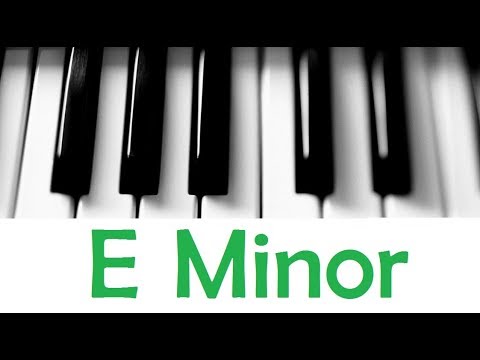
You can hear a diminished chord used in this way in the song "God Only Knows" by The Beach Boys. Minor chords, like major chords, contain three basic keyboard notes, a root note, third, and fifth. To play a minor chord, select any root note, then count three half-steps up to the third. From the third, count two whole-steps to find the fifth.
We'll be looking at D-sharp or E-flat minor 's history, its use in popular music, and whether or not it's hard to play it on the guitar. We'll also jam through a few of the key's songs and chord progressions. The chord progression from this website shows that the 1, 4, and 5 degree are to be Cm, Fm, Gm. But since we are in the harmonic minor scale, the 7th note of the scale , is raised by one semitone, so it is now B natural.
Chords In The Key Of E Flat Minor This makes the chord progression to be Cm, Fm, G, and now makes it sound better. In this guitar theory lesson, we're going to learn how to find the chords in a major key. This is very important for when you start writing your own songs and when you want to figure your favorite songs out for yourself.

It's important to note that the first step to knowing which chords occur in a major key is having a good understanding of the major scale. First we need to understand what a key even is. In Western classical music, the idea is pretty straightforward. Each major key is generated entirely from a major scale. If you pick any note from the scale and then go up skipping every other note, you get a chord. The seven chords you can get from the C major scale this way are C major, D minor, E minor, F major, G7, A minor and B diminished.

Taken together, these are the chords that comprise the key of C major. Because they consist entirely of notes from the C major scale, you can use the C major scale over all of them, and everything will fit. Be aware that not every note will sound equally good in every situation, you need to use your ear for that. You can use these popular progressions to write your own music.

It's not necessarily wrong to do that, it's just not common in music. But if your creativity takes you there, and it sounds good, go for it. The Locrian mode is best know as the seventh mode of the major scale, but it is also the second mode of the harmonic minor scale aka Locrian natural 6 mode. This is the basic mode to play over a m7b5 (half-diminished) chord. Phrygian mode is a minor scale that has a Flamenco or Middle Eastern feel. Lydian mode is a major scale with a floating, dreamlike quality.
Jazz and the brainier forms of metal use the melodic minor scalewhose chords and modes are wonderfully freaky. Fortunately, none of these scales are as common in rock and pop as the ones above. That takes care of standard practice from classical music. But now you need to deal with a whole other harmonic universe, the modes.

A very common mode for rock and pop is Mixolydian. The C Mixolydian mode is C, D, E, F, G, A, and B-flat. The chords you get from this scale are C7, D minor, E diminished, F major, G minor, A minor, and Bb major. So if you see a song that starts and ends on C7, and that has Bb chords in it, you need to use your C Mixolydian to sound correct.

In rock, Mixolydian is more common than plain major, so you should expect to see it a lot. As you see, the 3rd, 6th, and 7th notes in the minor scale are "flatted" respect to the major scale. The chords symbols just refer to this fact, warning us that their root notes are lower than what we would expect from a major scale.

In other words, with the symbol III we would indicate an E major chord, so we need to specify the flat in front of it as bIII to indicate the Eb chord. Notice there is only one 13th chord in a key, with seven different names depending on the root of the chord when played. Also notice that when you add a 6th note to a triad, the new chord has the same notes as another triad with an added 7th, E♭add6 has the same notes as Cm7. When playing in a Major Key, notes outside of the key may be added, creating chords not shown above. When a note outside of the Key is added to a chord, the note is considered an accidental note and would need to be marked in the name of the chord.
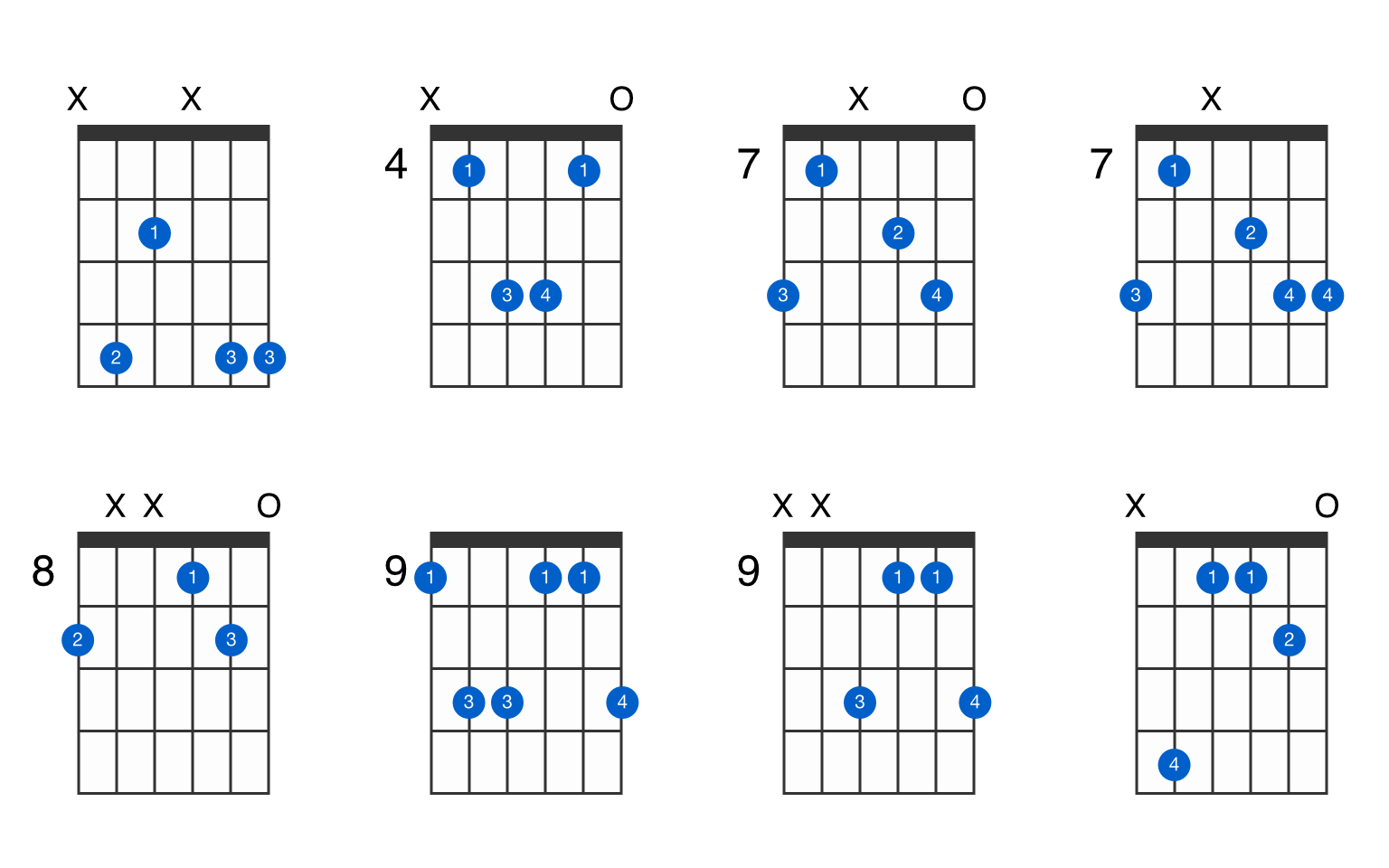
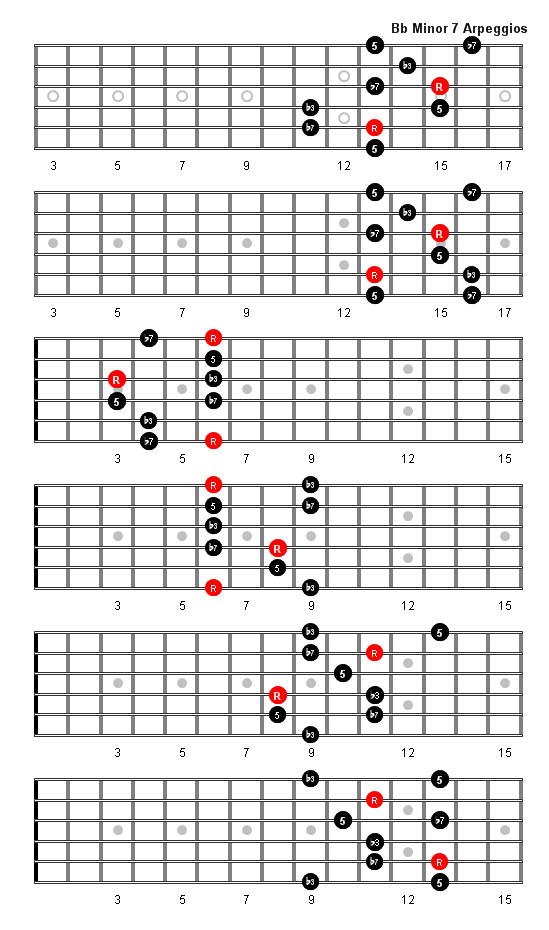
The E flat minor chord is most commonly played as a root-5 bar chord, starting on the 6th fret. It is enharmonically the same as the D sharp minor chord, but Ebm is the most common version of the two. Like the major scale we can also build 7 chords of the minor scale.

In fact the minor scale is relative to the major scale. When you play the major scale starting on the 6th degree and play seven notes ascending in the scale you are actually playing a minor scale. Once I learned how to build chords of a major or minor scale, the logic of chord progressions made much more sense. The harmonic minor scale contains seven notes, these are the same as the natural minor scale except the seventh degree that is raised by one semitone. The first scale built on the first degree of is the C harmonic minor scale is obviously the C harmonic minor scale. It will be used to play over the minor major seventh chord, corresponding to the first degree .

An interesting thing about the chords borrowed from the parallel minor key is that they are frequently the major chords from the minor key. So, in a major key, which only has three major chords—I, IV and V (you better know that by now!), the borrowed chords give a composer more major chords to work with. The ♭III major triad contains two notes outside of the major key. An E♭ major chord (E♭ G B♭) played in the key of C will have an E♭ and a B♭ from outside of the key of C.
In the key of C, E♭ and a B♭ would be a flat 3rd and flat 7th. So, the ♭III chord often evokes a bluesy sound. As a result, you will hear this sound in lots of blues-influenced styles like soul, R&B, rock, and funk. Note again that chords i and iv are minor chords.

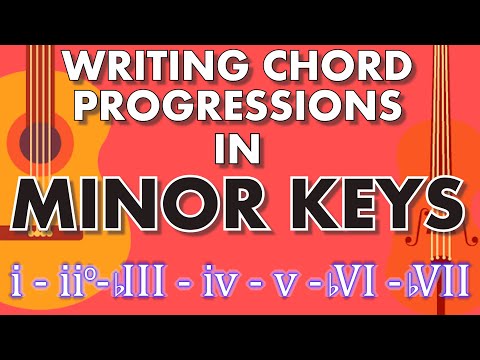
Chords III, V, VI and VII are major chords and chord ii° is a diminished chord. You can tell right away that this song either changes keys or simply plays a chord outside of the key. I can tell because you can have 3 major chords, but two are a step apart. Having an E major and E minor chord is another clue. With that said, the song might change keys in the middle.

The minor key is so versatile, spanning across just about every genre, from rock to pop to jazz to blues. It's really worthwhile to learn some songs in a minor key, and definitely worth it to explore your creative side with the various minor scales. I'll be focusing on the natural minor scale, the harmonic minor scale, and the melodic minor scale. Minor chord progressions do tend to sound sad. But that isn't the only emotion these chord progressions can provoke.
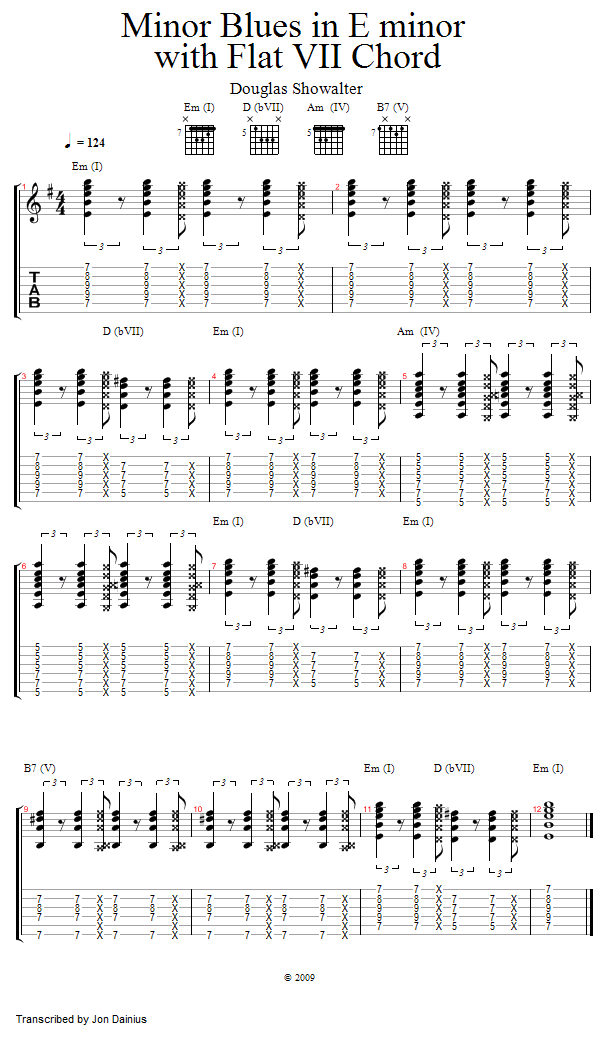
Rather, think of them as adding flavor to songs. So if you want a poignant song that makes people think about the lyrics, minor keys can help with that. At School of Rock, our students are able to learn theory, apply what they learn to their instrument, rehearse with a band, and then get on stage and perform a rock concert! Learning the different types of chords and how to play them on the piano is a lot of fun, and opens up doors to understanding and playing all types of music. As you learn more songs, and even write your own, you'll find endless combinations of piano or keyboard chords that create different sounds and moods. It's a little awkward but not hard to get a good sound out of this one as the fingers are relatively far apart.

If you have trouble, don't hesitate to use your Uberchordapp to help you improve your tone and timing and to try out new rhythms and strumming techniques. D#/Eb minor is liked by jazz and blues pianists because they get to use all the black keys, so if you plan to jam much with a blues pianist, get to know this key! The key of D-sharp minor / E-flat minor is not too common among orchestral or guitar compositions, and is only slightly more common for classical piano pieces. You may find yourself needing to accompany a jazz or blues pianist one day, and they may just want you to play in D-sharp / E-flat minor. Maybe you're thinking, why would we ever do this? Using a different note than the root in the bass creates a different kind of sound.

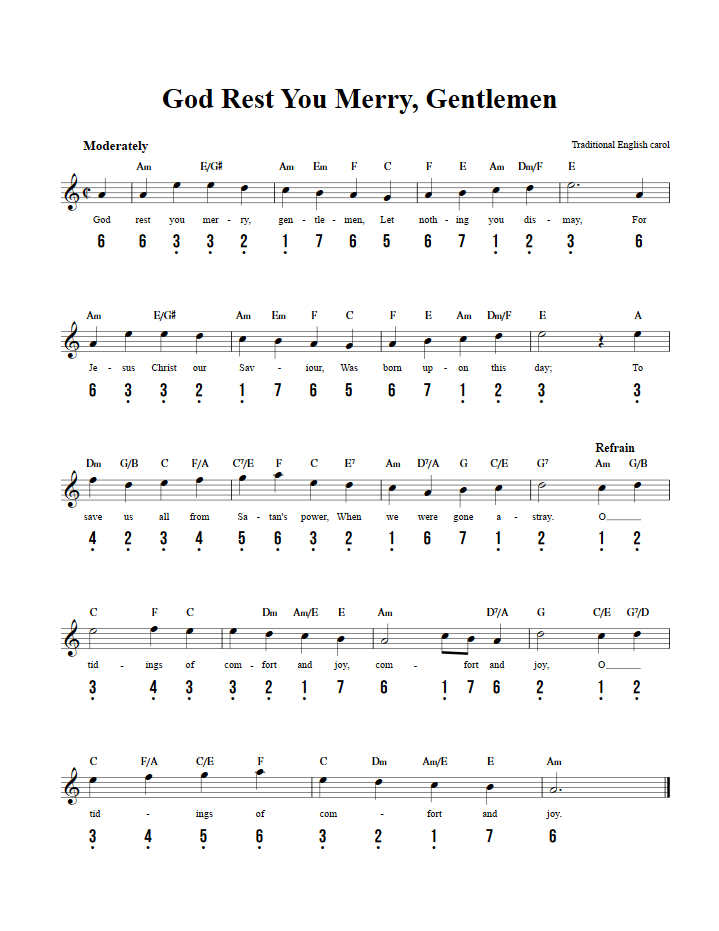
It's also used to make chord progressions sound slightly 'smoother' because it often allows for a bass line that moves up or down in small steps. For example, compare the first and second lines in this chord progression. The only difference is the G# in the bass in the third chord. This is very close to the key of E minor , which is the relative minor of G major. The exception is that the Dmaj11 has a major 7th in it (C#) instead of C. B minor does not include C# unless you're playing a Bm9 chord.

The C# would resolve nicely to the Am7 (1/2 step movement between chords). This is a case where the out-of-key note may add interest to the progression. An easy way to test this is by omitting the C#. Before moving on, you'll want to familiarize yourself with thetheory of the major scale theory on guitarbefore continuing this lesson.
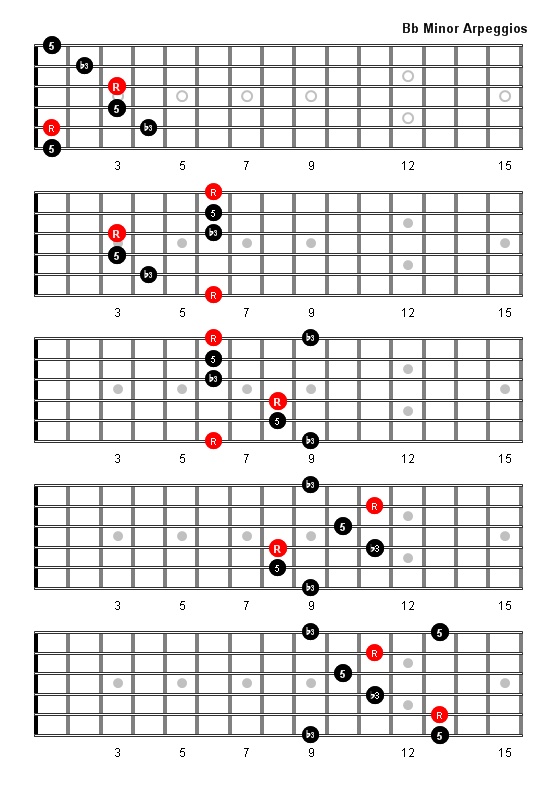
So the chords in E will root on the notes along the E major scale, since all chords in a major key are formed by notes from their respective diatonic scale. Minor chords are also very common in rock and pop music. "Comfortably Numb" is an example of a rock song that begins with a minor chord. Most rock and pop songs use a mixture of major and minor piano chords. There is usually more than one place on a guitar where a chord can be played. To figure out places to play a chord, write the notes of the chord down in a text file and then visit the Major Key position charts on guitar.
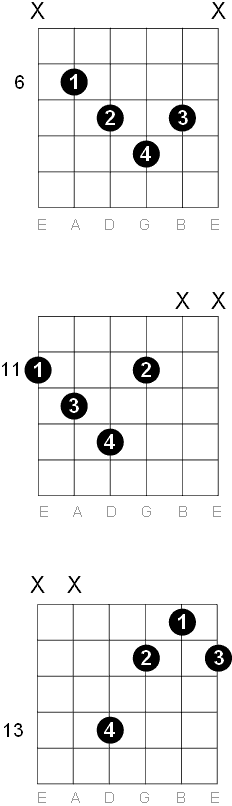
Find the notes on the chart and think of how to play all three notes. You do not have to play all six strings to play a chord. The positions are shown in the key of C Major. Just remember that a sharp (♯) is one fret up from a note, a flat (♭) is one fret down. On the sixth string of a guitar, the F is on the first fret.

This is a good way to start learning some chord fingering. As you get more comfortable with this and other chords, begin practicing other techniques for playing the E-flat minor chord, particularly the barred version. Only the chord progression will be same for the A minor and C major scale.


No comments:
Post a Comment
Note: Only a member of this blog may post a comment.